This section showcases the depth and variety of my academic and non-academic work spanning journal articles, books, chapters, and public commentary on four different research themes. Read more about the research themes here.
Spacing
Journal Articles
- Muriaas, R. & Peters, Y. (2025), ”Attitudes To Gender Quotas: Why and Where to Adjust Gender Imbalance in Leadership’‘, European Journal of Political Research, 64(1), 181-206.
- Mayne, Q. & Peters, Y. (2023), ”Where You Sit Is Where You Stand: Education-Based Descriptive Representation and Perceptions of Democratic Quality”, West European Politics, 46(3), 526-549.
- Tatham, M. & Peters, Y. (2023), ”Fueling Opposition?: Yellow Vests, Urban Elites and Fuel Taxation”, Journal of European Public Policy, 30(3), 574-598.
- Wang, V., Muriaas, R. & Peters, Y. (2021), ”Affirmative Action Measures and Electoral Candidates’ Positioning in Zambia”, The Journal of Modern African Studies, 59(4), 507-533.
- Peters, Y. (2021), ”Social Policy Responsiveness in Multilevel Contexts: How Vertical Diffusion of Competences Affect the Opinion-Policy Link”, Governance, 34(3), 687-705.
- Linde, J. & Peters, Y. (2020), ”Responsiveness, Support and Responsibility: How Democratic Responsiveness Facilitates Responsible Government”, Party Politics, 26(3), 291-304.
- Cappelen, C. & Peters, Y. (2018), ”Diversity and Welfare State Legitimacy in Europe: The Challenge of Intra-EU Migration”. Journal of European Public Policy, 25(9), 1336-1356.
- Cappelen, C. & Peters, Y. (2018), ”The Impact of Intra-EU Migration on Welfare Chauvinism”, Journal of Public Policy, 38(3), 389-417).
- Peters, Y. (2018), ”Democratic Representation and Political Inequality: How Social Differences Translate Into Differential Representation”, French Politics 16(3), 341-357.
- Arnesen, S. & Peters, Y. (2018), ”The Legitimacy of Representation: How Descriptive, Formal and Responsiveness Representation Affect the Acceptability of Political Decisions”, Comparative Political Studies 51(7), 868-899.
- Peters, Y. (2016), ”(Re-)Join the Party! The Effects of Direct Democracy on Party Membership”, European Journal of Political Research, 55(1), 138-159.
- Peters, Y. (2016), ”Zero-Sum Democracy? The Effects of Direct Democracy on Government Election”, Political Studies, 64(3), 593-613.
- Peters, Y. & Ensink, S.J. (2015), ”Differential Responsiveness in Europe: The Effects of Preference Difference and Electoral Participation”, West European Politics, 38(3), 577-600
Book Chapters
- Helliesen, M., Mathisen, R. & Peters, Y. (2025), ”The Fairest of Them All? Political Representation and Equality in Norway”. In. K. Kolltveit, E. H. Allern, M. Braut-Hegghammer & B. E. Rasch (Eds.), The Oxford Handbook of Norwegian Politics. Oxford: Oxford University Press.
- Helliesen, M. & Peters, Y. (2025), ”The Political Perspective on Social Sustainability: Age-Based Representation”. In M. Vaalavuo, K. Nelson & K. Kuitto (Eds.), Social Sustainability in Aging Welfare States. Cheltenham: Edgar Elgar.
- Mathisen, R. & Peters, Y. (2023), ”Political Participation and Unequal Representation: Addressing the Endogeneity Problem”. In N. Lupu & J. Pontusson (Eds.), Unequal Democracies. Public Policy, Responsiveness, and Redistribution in an Era of Rising Economic Inequality. Cambridge: Cambridge University Press.
- Peters, Y. (2023), ”Political Participation”. In M. Grasso & G. Marco (Eds.), Elgar Encyclopedia of Political Sociology. Cheltenham: Edgar Elgar.
- Peters, Y. (2016), ”Hollower Democracy? Studying the Consequences of a Changing Demos”, in F. Muller-Rommel & F.C. Bertoa (Eds.), Party Politics and Democracy in Europe: Essays in Honor of Peter Mairs, Abindgon/New York: Routledge.
Spacing
Books
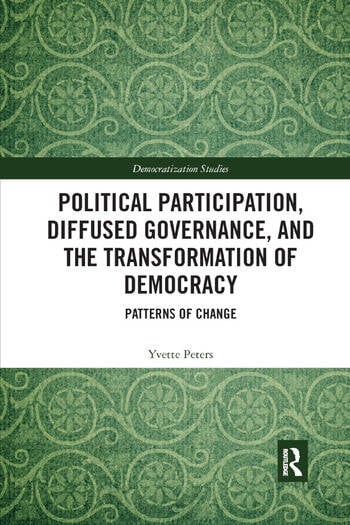
”Political Participation, Diffused Governance, and the Transformation of Democracy: Patterns of Change”
Oxford/New York: Routledge
Peters. Y. (2018)
Although democratic governments have introduced a number of institutional reforms in part intended to increase citizens’ political involvement, studies show a continued decline in regular political engagement. This book examines different forms of political participation in democracies, and in what way the delegation of public responsibilities—or, the diffusion of politics—has affected patterns of participation since the 1980s.
The book addresses this paradox by directly investigating the impact of institutional changes on citizens’ political participation empirically. It re-analyses patterns of political participation in contemporary democracies, providing an in-depth time series cross-sectional analysis that helps develop a better understanding of how variation in political participation can be explained, both between countries and over time. As such, it develops an institutional theoretical framework which can help to explain levels of participation and shows that, instead of displaying more political apathy, citizens have reallocated or displaced their activities to a broader array of forms of participation.
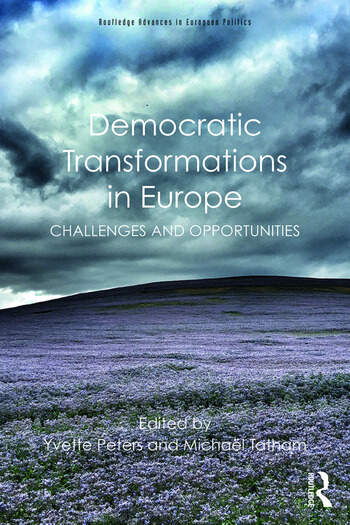
Democratic Transformation in Europe 31: Challenges and Opportunities
(edited book). London/New York: Routledge.
Peters, Y. & Tatham, M. R. (2016)
Democracies evolve. Their evolution is not only key to their survival; it is also a reflection of the changing environment in which they operate. This book contributes to the analysis and understanding of how democratic states have transformed over time by examining a number of challenges and opportunities that they face.
With a focus on ‘Europe 31’, understood as the EU28 plus Switzerland, Norway, and Iceland, the book brings together separate strands of literature which often remain disconnected in political science narratives. Looking at citizen–state relations, the restructuring of politics and institutions of the state, and developments which reach ‘beyond and below’ the state, it interrogates a variety of issues ranging from the decline of parties or the re-emergence of nationalism as a political force, to liberal challenges to social democracy, terrorist threats, and climate change. The book combines these different dimensions into a comprehensive overview of the state of contemporary democracy, its challenges and opportunities, and its dynamic capacity to adapt. In other words, it deals with the perpetual threats to and transformations of democracy, and the state’s ability to protect and strengthen its democratic attributes.
- Peters, Y. & Tatham, M. R. (2016) ”The Transformation of Democracy” in Y. Peters & M. R. Tatham (Eds.), Democratic Transformations in Europe 31: Challenges and Prospects. London/New York: Routledge
- Peters, Y. & Tatham, M. R. (2016) ”The Contemporary State of Democracy in a Transformed Europe”, in Y. Peters & M. R. Tatham (Eds.), Democratic Transformations in Europe 31: Challenges and Prospects. London/New York: Routledge
- Peters, Y. (2016) ”Displacing Politics: The State of Democracy in an Age of Diffused Responsibility”, in Y. Peters & M. R. Tatham (Eds.), Democratic Transformations in Europe 31: Challenges and Prospects. London/New York: Routledge
Other/Non-Academic Work
- Peters, Y. (05.04.2016), ”Political Parties Which Operate in a Direct Democratic Context Tend To Have A Higher Number of Members” on Democratic Audit UK: http://www.democraticaudit.com/?p=20815
- Peters, Y. (03.06.2015), ”Electoral Participation Has An Impact on Political And Socioeconomic Inequality” on Democratic Audit UK:http://www.democraticaudit.com/?p=13578
- Peters, Y. & Ensink S.J. (2015) discussed in McElwee, S. (28.10.2015), ”The More Unequal The Country, The More The Rich Rule” in Al-Jazeera America:
http://america.aljazeera.com/opinions/2015/10/the-more-unequal-the-country-the-more-the-rich-rule.html
 Yvette Peters